What it earns
What does dimming earn you?
A compensation or a saving, depending on who dims.
Three ways
Who dims determines what you get.
In the app you choose who may dim your solar panels. You can switch on more than one.
Dim along when the grid in your area is full.
Do you live in an area where your grid operator has solar panels dimmed? Then you receive compensation for the generation that is dimmed. Whether this applies to your address, you see during sign-up right after entering your postcode and house number. That’s also where you see the compensation and give permission to dim on behalf of your grid operator.
How often and how long we dim depends on the weather forecast and the expected electricity use in the region. It mostly happens on days with low consumption, such as weekends and public holidays, around midday when the sun is strongest.
- Compensation
- € 0.25 per dimmed kWh
- When
- Mostly at weekends and on public holidays, around midday
- Payout
- Monthly, once you’re above € 5
No more paying when the price drops below zero.
With a dynamic contract, we switch your panels off in the quarter-hours when your electricity price is negative. Everything you use then comes from the grid at that negative price. As soon as the price is positive again, we switch your installation back to full power.
To calculate your price we take your energy supplier’s surcharge, net metering and taxes into account. You set yourself whether your feed-in in 2026 still falls under net metering. That’s the case if you use more than you feed in over the year.
- When
- In every quarter-hour with a negative price
- What you notice
- You see the savings directly on your energy bill
- From 2027
- Net metering ends. You then easily save € 30 to € 50 a year
Dim when your supplier asks for it.
Energy suppliers sometimes want to limit feed-in too. For example at negative market prices, when consumption deviates from the forecast, or in quarter-hours with unexpectedly high feed-in (imbalance).
In the app you can already give permission to dim on behalf of your energy supplier. We’re in talks with most Dutch suppliers to make dimming solar panels part of smart energy contracts after net metering ends in 2027.
- Status
- Coming soon, in talks with most suppliers
- Why suppliers dim
- Negative market prices, forecast deviations and imbalance
- Permission
- You can already give it in the app
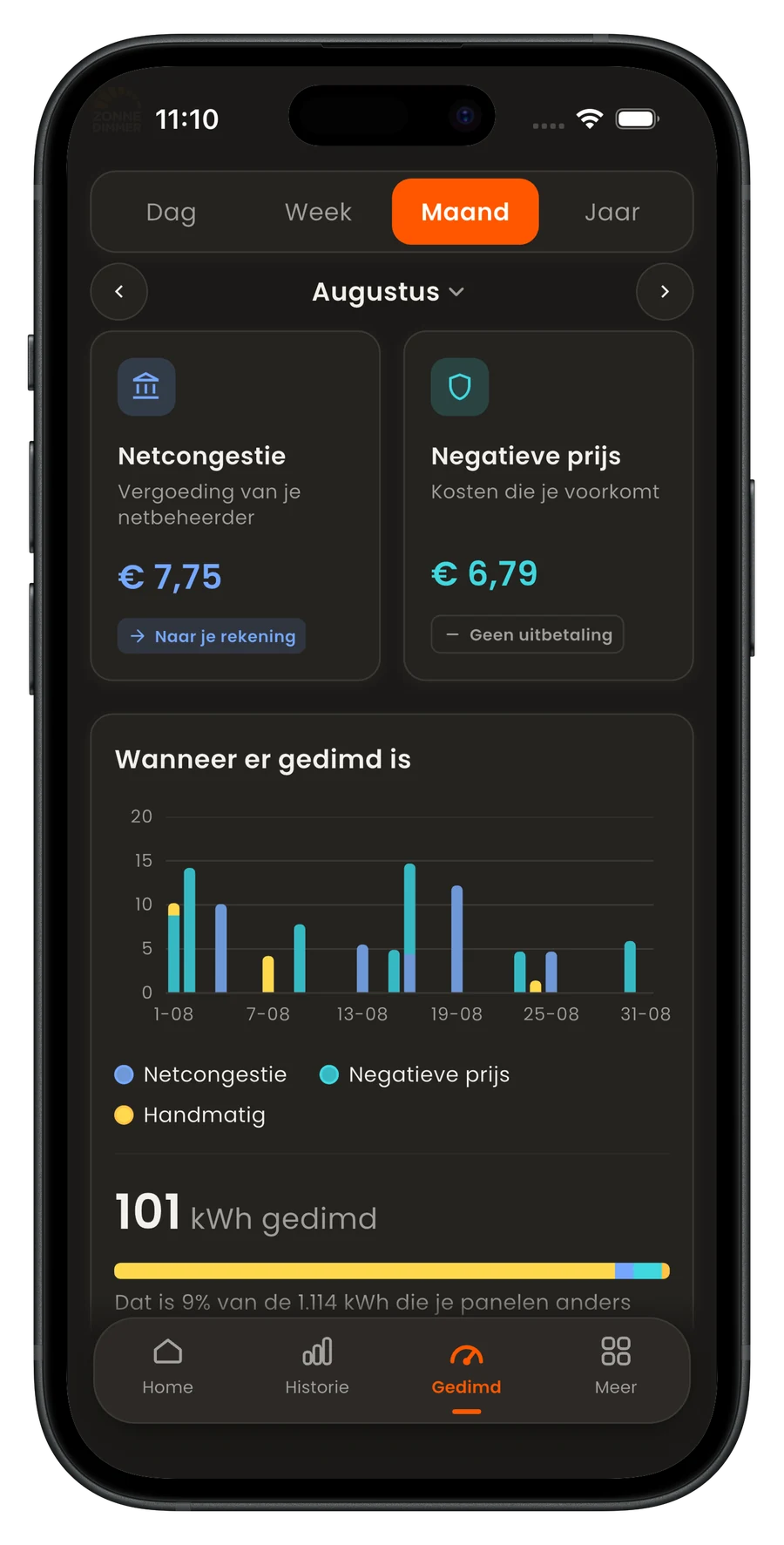
Calculated fairly
Every dimmed kWh shows up in the app.
How much was dimmed
While dimming, your panels generate less. How much less, we calculate from your installation’s historical generation and the local solar irradiance measured by KNMI. That way we account for the orientation of your panels and the weather in your area.
Who pays the compensation
The party that has your solar panels dimmed pays the compensation, and we pay it out to you. If you dim at negative prices, there’s nothing to pay out: the saving goes straight into your energy bill.